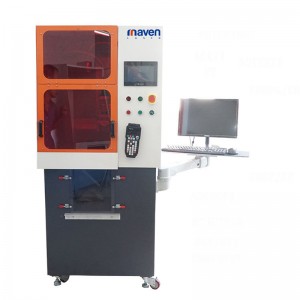


New Industrial Portable Desktop Laser Cutting Machine Mini Desktop Laser Engraver and Cutter

New Industrial Portable Desktop Laser Cutting Machine
Classic Semi-Enclosed Structure Stable, Safe & Durable
Mobile Box-Type Worktable Flexible for DIY & Versatile
ApplicationsMulti-Platform Operating System
Easy & Convenient to Use
Integrated Ventilation System Dust, Smoke & Heat Removal
Self-Developed Core Components. Superior CostPerformance


Specification
| Output Power | 800W/1200W |
| Effective cutting size | 300mmx300mm |
| Z-axistravel | 40mm(Ajust the height accordingly) |
| Empty shift acceleration | 0.3G |
| Positioning accuracyRepeated | +/-0.1mm |
| positioning accuracy | +/-0.06mm |
| Cutting thickness | SS:s2mm (air),AL:s1.5mm (air).Copper: s1mm (air)Single-phase |
| Voltage | 220V 50/60Hz |
| Weight | 70kg |
| Machine size | 600mmX260mmX480mm/600mmX260mmX580mm |
| Cutting chamber size | 550mmX620mmX500mm/550mmX620mmX500mm |

Technical sub-questions
1. How precise is the cut, and what does that precision actually enable?
The machine holds ±0.1mm repeated positioning accuracy and ±0.06mm single-pass positioning accuracy, with empty-shift acceleration of 0.3G. In practice, this means:
- Stainless steel up to 2mm cuts cleanly with compressed air only (no assist gas required)
- Aluminum up to 1.5mm and copper up to 1mm cut the same way, air-assisted
- A 300mm × 300mm effective cutting area covers most small-part and prototype jobs without repositioning the material
At 0.3G empty-shift acceleration, the head moves fast between cuts without accuracy drift, which is what keeps repeated positioning inside ±0.1mm across a full job rather than degrading over time.
2. Can it handle irregular or uneven materials, and how is height adjusted?
Yes — the Z-axis travels 40mm, which is used to adjust cutting head height for material thickness variation, warped sheet stock, or stacked layers. This is a mechanical, industrial-grade adjustment rather than a fixed-focus head, so operators working with reclaimed metal, uneven jewelry blanks, or mixed-thickness batches don't need a separate leveling jig. Combined with the mobile box-type worktable, the bed can be repositioned to bring different zones of a large or irregular piece into the 40mm adjustment range without dismounting the material.



FAQs
1. Does this machine need water cooling to run reliably? No — it uses a self-developed air-cooled laser source, so there's no chiller to maintain or top up. Water-cooled fiber lasers need periodic coolant checks and are vulnerable to freeze damage or algae buildup in the loop; air cooling removes that maintenance line item entirely. For a desktop-class 800W/1200W unit, air cooling is sufficient because the duty cycle and chamber size don't generate the sustained thermal load that larger industrial cutters see. This also simplifies transport and setup, since there's no coolant to drain before moving the unit between locations.
2. What's the thickest metal this machine can cut without assist gas? Stainless steel up to 2mm, aluminum up to 1.5mm, and copper up to 1mm — all using compressed air rather than nitrogen or oxygen assist gas. This matters because assist-gas cutting adds a recurring consumable cost and requires gas cylinder storage and regulation hardware. For sheet stock at or under these thicknesses, air-only cutting keeps operating costs closer to just electricity. Thicker material or cleaner edge finishes on reflective metals would typically need assist gas on most fiber lasers, so these figures define the practical ceiling for gas-free operation on this unit.
3. Can this cutter handle jewelry-scale precision work? Yes — the ±0.06mm single-pass positioning accuracy is fine enough for small jewelry components, and the 300×300mm bed suits batches of small parts rather than large sheet stock. Jewelry cutting typically demands tight tolerances on small, often irregular blanks, which is where the 40mm Z-axis adjustment also helps, since it accommodates slightly uneven stock without a separate fixture. The semi-enclosed structure additionally contains fine metal dust from precious-metal cutting, which matters more in jewelry workflows than in general sheet metal work.
4. How much space and electrical setup does installation require? Very little — the unit measures 600×260×480mm (or 600×260×580mm) externally, weighs 70kg, and runs on standard single-phase 220V power at 50/60Hz. There's no need for three-phase wiring, a dedicated gas line, or a chiller loop, which are common installation requirements for larger industrial cutting systems. This makes it viable for a workbench in a small workshop, a jewelry studio, or a home-based fabrication setup, provided there's standard mains power and basic ventilation clearance around the enclosure.
5. What does the mobile connectivity feature actually do? It enables remote monitoring of the machine's operating status from a phone or connected device, rather than requiring an operator to stay at the machine for the full cutting cycle. For a desktop-class unit often run alongside other tasks in a small shop, this means checking job progress or completion remotely instead of watching the enclosure. It's a monitoring feature, not remote job programming — cutting jobs are still set up and started at the machine itself via its multi-platform operating system.
6. What kind of workshop is this machine actually built for? It's built for small-batch, small-part cutting in space-constrained settings — jewelry studios, prototyping shops, and light fabrication businesses — rather than high-volume industrial sheet cutting. The 300×300mm bed, 70kg weight, and single-phase power all point to a bench-top installation, while the ±0.1mm repeated accuracy and 2mm-and-under metal capacity match precision small-parts work more than heavy plate cutting. Shops needing larger sheet capacity or thicker-metal cutting with assist gas would typically need a larger industrial fiber laser cutter instead.