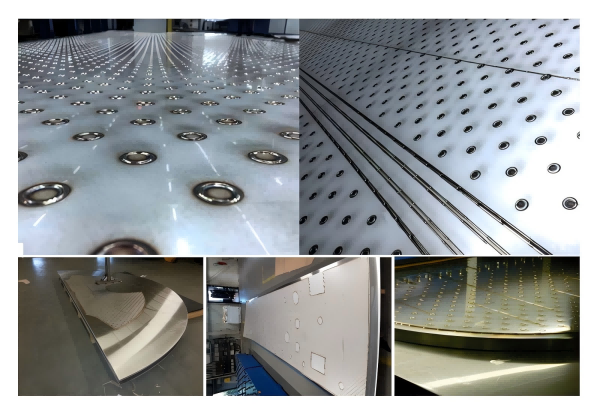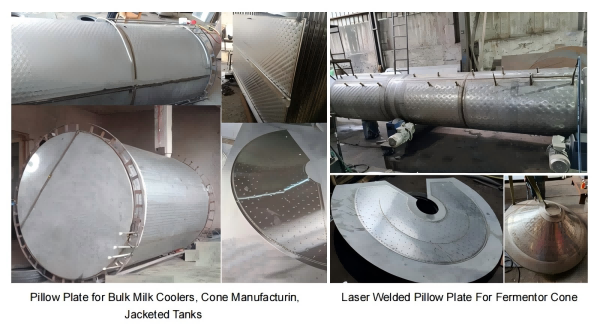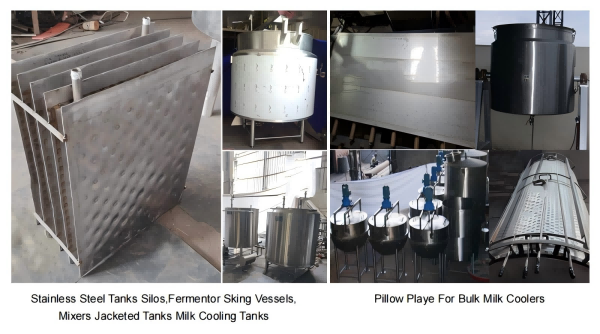


new type of welding method pillow plate fully automatic continuous laser welding machine for Single Double embossed plates
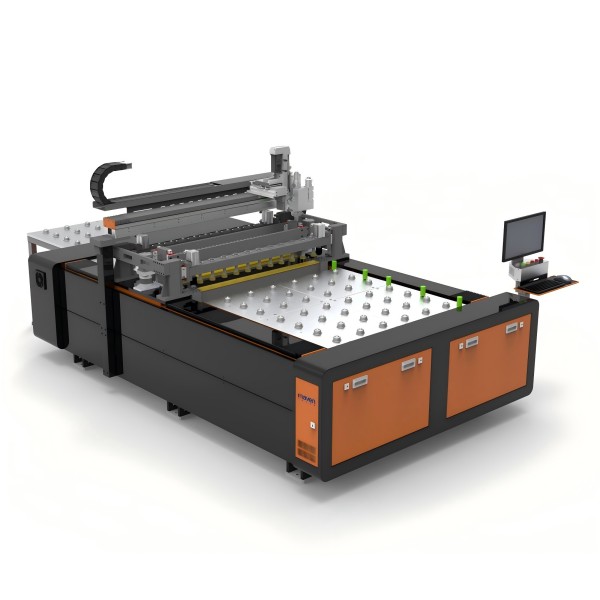
Pillow Plate Laser Welding Machine
1. How does laser welding prevent the leak points common in manual welding?
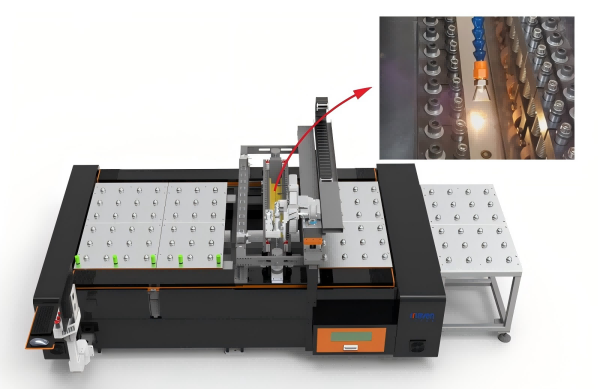
Traditional pillow plates rely on manual spot welding or resistance welding, where weld density is uneven and weak points are common — once the plate is inflated under pressure, any weak spot can blister or rupture. This machine instead uses continuous fiber laser welding: the laser is transmitted through fiber optic cable, focused into a parallel beam, and run continuously along the seam — not applied point by point like spot welding.
Because the light output is continuous rather than pulsed, the weld forms one dense, unbroken line instead of a series of connected spots, which removes the "gap between spots" failure mode typical of manual welding. A CCD camera monitoring system tracks the weld path in real time, so operators can observe the process, and the energy distribution across the weld is more even.
Data gap: The manufacturer's page does not publish specific leak-test figures (e.g., pressure rating in bar, leak rate standard). If you're using this for technical sales conversations, ask the manufacturer for actual pressure-test reports or third-party inspection data rather than relying on the "continuous laser = tighter seal" principle alone.
2. What actually drives the heat-transfer performance of the inflated pillow pattern?
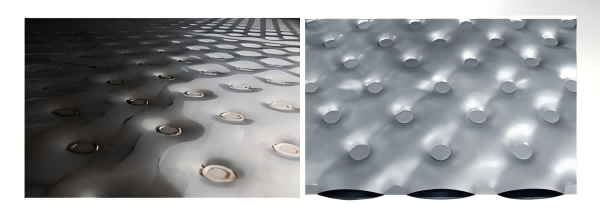
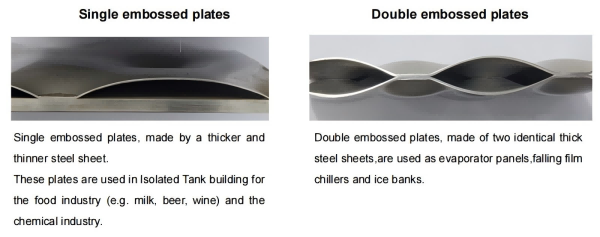
Pillow plates come in two types: single embossed and double embossed. Single embossed plates weld a thinner top plate onto a thicker base plate — only the top plate deforms when inflated — and are typically used as jackets around vessels (e.g., heating/cooling layers on storage tanks). Double embossed plates use two plates of equal thickness, both of which bulge when inflated; these are usually stacked into standalone heat exchangers for full-immersion applications.
The raised pattern forces the fluid into a turbulent flow instead of a smooth laminar flow along a flat channel. That turbulence increases contact between the fluid and the plate surface, which is the core efficiency advantage pillow plates have over flat-plate exchangers. A common real-world application in this space is continuous production of 0.5°C ice water using a falling-film chiller, as well as cooling bulk solids like sugar or fertilizer (NPK, CAN).
Data gap: The manufacturer's page does not disclose a specific heat-transfer coefficient (W/m²·K) or channel depth for plates produced on this machine — only the operating principle and typical use cases. Actual thermal performance depends on the medium, flow rate, and temperature differential, and is usually calculated case-by-case rather than from a single published number.
3. How does the same machine adapt to different industries — dairy, chemical, pharmaceutical?
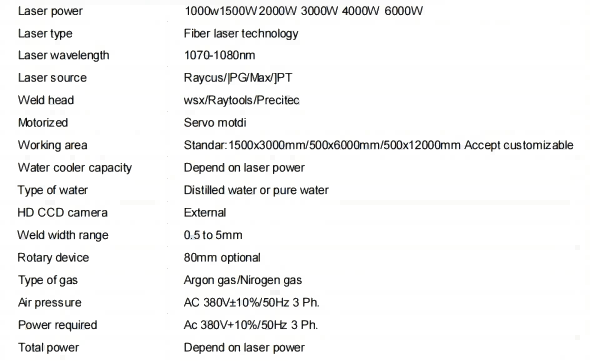
The system is built from two parts — a "welding host" and a "welding worktable" — and comes in six laser power options: 1000W, 1500W, 2000W, 3000W, 4000W, and 6000W. The manufacturer configures the housing and worktable to match a customer's production line rather than shipping one fixed configuration.
Lower power (1000W–2000W) suits thinner plates, small orders, or prototyping. Higher power (4000W–6000W) suits thicker plates and continuous mass production. The laser source uses imported components, rated by the manufacturer at 10+ years of service life — a figure that typically refers to the light source itself, not a maintenance-free guarantee for the whole machine.
By industry: double-embossed plates are common in dairy, beverage, and brewing tanks; single-embossed plates are common as heating/cooling jackets in chemical and pharmaceutical storage tanks.
Data gap: The page does not publish actual welding speed (m/min), yield rate, or typical commissioning time by power tier — these figures are usually shared during sales conversations, not on the public product page.
FAQ
Q1: Is laser-welded pillow plate better than resistance-welded or TIG-welded pillow plate? Continuous laser welding produces a denser, more continuous seam, better suited to high-density automated production. Resistance/TIG welding has a lower equipment cost and suits small-batch runs or repairs. Which is "better" depends on your production volume and precision needs, not a blanket rule.
Q2: Should I choose single embossed or double embossed plates? Choose single embossed if you need a heating/cooling jacket around a tank or vessel (thick base + thin top plate). Choose double embossed if you need a standalone, fully-immersed heat exchanger (two equal-thickness plates). The choice comes down to whether the medium flows inside or around the plate.
Q3: Which laser power — 1000W or 6000W — should I choose? It depends on plate thickness and volume. Use 1000–2000W for thin plates, small orders, or prototyping. Use 4000–6000W for thick plates and continuous high-volume production. Higher power doesn't mean better welding quality — it needs to match plate thickness.
Q4: Can this weld titanium plates? Yes. Stainless steel and titanium are the two common materials for pillow plates, chosen based on how corrosive the fluid medium is — titanium resists corrosion better but costs more. The manufacturer's page doesn't specify whether titanium requires adjusted laser parameters, so confirm that directly with them.
Q5: How long is the payback period for this machine? There's no published payback period or throughput figure, so this can't be answered definitively. Payback speed depends on your order volume, the yield-loss you currently see with manual welding, and this machine's actual welding speed — ask the manufacturer for real production-line yield and cycle-time data before estimating ROI.
Q6: What temperature and pressure can the welded pillow plate withstand? No specific temperature or pressure test values are published — only a general claim of "high temperature and pressure resistance." Actual pressure tolerance depends on plate thickness, weld quality, and inflation height. Request a third-party pressure-test report rather than relying on the marketing description alone.